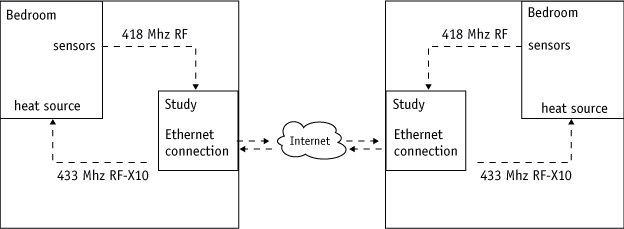
Ideally, the Sensing Beds
are two full-size beds in different locations. Each bed would
have a grid of 12 pressure sensors located under the mattress
pad to track the location of the sleeper as well as a microcontroller
wirelessly transmitting the position data to another microcontroller
located near an Ethernet jack. That microcontroller sends
the data over the Internet to the other location. There, a
microcontroller near an Ethernet jack transmits the position
data (again using RF) to an X10 controller that turns on the
appropriate heating pads under the mattress pad in the second
bed.
Why so many different components?
In a lab, we can count on having an Ethernet jack nearby our
installation. However, our homes are a different matter. Unless
there's a wireless home network, Internet connectivity is
usually far away from the bed. Until the day normal houses
are covered with a cloud of connectivity (or data moves over
powerlines), transferring data from one communications network
(the Internet) to another (the home wiring system) will remain
troublesome. Hence the project's modular - and wireless -
design. Sending data over the home wiring using the X10 protocol
also lets us avoid nasty accidents with relays and hacked-up
AC power cords.
The benches
Equipping two beds with full sensor networks and heating pads
proved to be impractical. Given X10's limitations as a home
networking solution, ITP's wiring simply could not accommodate
the number of devices per circuit required. Instead, we chose
to prototype the Sensing Beds on a pair of benches in ITP's
lounge.
>> next
|