|
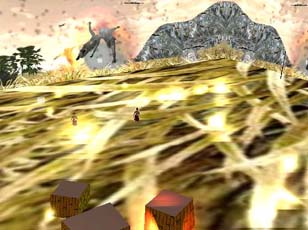
Overview
POV / POW is an interactive 3D scene that uses the familiar graphic
and audio vocabulary of 3D action games to represent the viewpoint
of those who are usually forgotten or unrepresented in games - the
child, the wounded, or the elderly. The goal of this game is to
remain alive in a battlefield without a gun. Losers get no second
chances.
Players
As a commentary on "realistic" action, POV/POW is aimed
at the hardcore gamers who like nonstop blood 'n' guts.
Limits
POV/POW appropriates the graphic language of action games, but provides
very limited interaction. It simply recreates the most iconic elements
of the experience - the explosions, the camera sights, first-person
cameras - in a minimally rendered space.
Comfort Zone
Sources of inspiration Dispatches
"However many times it happened, whether I'd known them or
not, no matter what I felt about them or the way they died, their
story was always there and it was always the same: it went, 'Put
yourself in my place.'"
- Michael Herr, Dispatches
Herr, a writer for Esquire, went to Vietnam in the middle
of the war to see what he could find. He emerged a year later with
persistent nightmares and the battlefield notes that became Dispatches,
his classic work of war reporting.
Reading Dispatches in a time of war is a quick, sharp reminder of
" And when I say realism, I mean realism. This isn't just
a buzzword. Everything is going to ooze realism."
- review of Soldier of Fortune, 3DActionPlanet.com
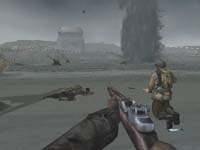
screenshot from Medal of Honor
Platforms
POV/POW was created on a PC using Virtools, but runs within a browser
using the Virtools web player.
Interface Design and Navigation
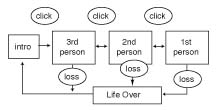
Start up
The player starts in a conventional action mode: as a sniper who
views a platoon's invasion of a small village through the sights
of a rifle.
Objectives
To survive, naturally. And to avoid killing civilians.
Entities
Most of the objects in the world are prefab, "action game"
objects - they are deliberately generic.
Objects The world is encased in a boxes textured with jpgs
from game screenshots. Within that, there are various huts made
out of simple hollowed-out primitives, "trees" made from
masked textures on planes, and some polyhedral hills. There are
no movable objects, only characters and scenery.
Characters As of now, I have modelled soldiers and not civilians,
since the project looks at video game war through the eyes of civilians.
Since I want to encourage identification with civilians, I did not
want to be too specific about the location/time of the scene. None
of the cameras, except for the battlefied view, are tied to a character.
Behaviors The characters run on preset paths through the
village.
Time
3D resources
Character modeling All the soldier characters are generic
characters from the Virtools library retextured with game screenshots.
Biped and animations The bipeds use "running" MegaMoCap
motions imported through 3DMax. The first-person camera located
on the battlefield is attached to an invisible character whose default
motion is "throwing a grenade."
2D resources
Textures All textures, where possible, have been taken from
screenshots of first-person shooter games.
Audio The au
Text
Data structure
Interactions
Between objects
Between movable elements and objects
Methods and properties
Functions Handlers and Properties
data management
game logic
time
navigation
3D interface The interface is handled through an "interface
manager" script, which checks to see which of the three buttons
has been clicked and changes the camera accordingly. As well, it
hides or reveals the "gunsight" depending on the identity
of the character represented by the camera.
2D interface
Input devices
The game uses only a mouse to simplify navigation through the world
and through the interface.
}
|