<?xml version="1.0" encoding="utf-8"?>
<feed xmlns="http://www.w3.org/2005/Atom">
    <title>confectious</title>
    <link rel="alternate" type="text/html" href="http://www.confectious.net/thinking/" />
    <link rel="self" type="application/atom+xml" href="http://www.confectious.net/thinking/atom.xml" />
    <id>tag:www.confectious.net,2008-08-03:/thinking//1</id>
    <updated>2011-09-20T23:11:43Z</updated>
    <subtitle>recently thinking about...</subtitle>
    <generator uri="http://www.sixapart.com/movabletype/">Movable Type Personal 4.12</generator>

<entry>
    <title>links for 2011-09-20</title>
    <link rel="alternate" type="text/html" href="http://www.confectious.net/thinking/archives/2011/09/links-for-20110-14.html" />
    <id>tag:www.confectious.net,2011:/thinking//1.1015</id>

    <published>2011-09-20T23:11:43Z</published>
    <updated>2011-09-20T23:11:43Z</updated>

    <summary><![CDATA[ Free Farm Stand SF produce giveaway (tags: food urban farming parks) Quick-pic Tuesdays: Waste Not, Want Not &quot;Chinese natural resource efficiency – combining vegetable scraps and incense at a grave in Wellington during Ching Ming festival. I’ve also noted...]]></summary>
    <author>
        <name>Liz</name>
        
    </author>
    
    
    <content type="html" xml:lang="en" xml:base="http://www.confectious.net/thinking/">
        <![CDATA[<ul class="delicious"><li>
                <div class="delicious-link"><a href="http://freefarmstand.org/">Free Farm Stand</a></div>
                <div class="delicious-extended">SF produce giveaway</div>
                <div class="delicious-tags">(tags: <a href="http://www.delicious.com/egoodman/food">food</a> <a href="http://www.delicious.com/egoodman/urban">urban</a> <a href="http://www.delicious.com/egoodman/farming">farming</a> <a href="http://www.delicious.com/egoodman/parks">parks</a>)</div>
            </li><li>
                <div class="delicious-link"><a href="http://www.randomspecific.com/waste-not-want-not">Quick-pic Tuesdays: Waste Not, Want Not</a></div>
                <div class="delicious-extended">&quot;Chinese natural resource efficiency – combining vegetable scraps and incense at a grave in Wellington during Ching Ming festival. I’ve also noted the use of broccoli stalk bases as sign holders by Chinese at the local farmers market. Making the most of what nature provides to support human endeavor – from faith to commerce.&quot;</div>
                <div class="delicious-tags">(tags: <a href="http://www.delicious.com/egoodman/religion">religion</a> <a href="http://www.delicious.com/egoodman/trash">trash</a> <a href="http://www.delicious.com/egoodman/food">food</a>)</div>
            </li></ul>]]>
        
    </content>
</entry>

<entry>
    <title>Notes from Susan Leigh Star colloquium</title>
    <link rel="alternate" type="text/html" href="http://www.confectious.net/thinking/archives/2011/09/notes-from-susa.html" />
    <id>tag:www.confectious.net,2011:/thinking//1.1014</id>

    <published>2011-09-15T18:42:20Z</published>
    <updated>2011-09-15T18:48:05Z</updated>

    <summary>Celebration of Leigh Star: Her Work and Intellectual Legacy San Francisco, September 9th-10th, 2011 I&apos;m told that there will be video posted, but in the meantime, these (partial, paraphrased, etc) notes might be helpful....</summary>
    <author>
        <name>Liz</name>
        
    </author>
    
    
    <content type="html" xml:lang="en" xml:base="http://www.confectious.net/thinking/">
        <![CDATA[<p>Celebration of Leigh Star: Her Work and Intellectual Legacy<br />
San Francisco, September 9th-10th, 2011</p>

<p>I'm told that there will be video posted, but in the meantime, these (partial, paraphrased, etc) notes might be helpful.</p>]]>
        <![CDATA[<p><em>John King - Triangulation from the Margin</em><br />
Talks about his relationship with Leigh and her time at UCI.<br />
Triangulation<br />
-	to calculate distance you need a baseline<br />
-	first use in surveying<br />
Margins<br />
-	ex: The archive of all of ancient Greek literature - the scholia (writing on the edges) was part of the document for scholars - but the archive left them out. <br />
Triangulating from inside and outside the margins onto the center. So you need to be able to change your point of view. </p>

<p><em>Dick Boland - The Concept of Boundary Objects and the Reshaping of Research in Management and Organization Studies</em><br />
-	"the ones who are marginalized know they are marginalized"<br />
-	started off studying "the soft underbelly of accounting" <br />
-	how do people make sense of and use representations in building arguments for interventions, changes, etc.<br />
-	his conclusion: "in naming 'boundary object' Leigh helped us all be more human in our research"<br />
-	she brought Wittengenstein into our everyday world <br />
o	helping us get "back to the rough ground" of multiplicity in forms of life and contention of meaning.<br />
o	Multiple human agents always involved and always in contention over meaning<br />
-	The proliferation of "____________ as a Boundary Object: Implications for ___________"<br />
-	Naming is powerful<br />
-	<shows cave paintings from Chauvet and Lascaux><br />
-	we make representations and boundary objects meaningful, differently<br />
-	how do we talk about the cave paintings as representations? <br />
o	Hermeneutic process (Gademer) - one mind tacking back and forth<br />
o	Communication models - assumes a well-formed message with a correct meaning<br />
•	Boundary objects always have two or more messages in contention<br />
o	Semiotics - triangle, sense, referent and signifier - how to get beyond insight that relation of signifier and signified in arbitrary? [well, you could go to Peirce...aha, he does that]<br />
o	And along came BOB (Boundary Object) - cracks open organizational representations - makes openness fundamental<br />
•	Asserts representational agency of human beings<br />
-	He points out that this is a big deal in organizational studies<br />
o	Success is seen to come from shared meaning, and failure from disparate meanings - so having multiple meanings there looks like the road to ruin<br />
o	Sensemaking collapsed to a single human and a single sense<br />
-	He studies distributed cognition and how CAD changed architects perspective on what their practice was and what their organizations would do in the future<br />
-	Walker Percy - argues against dyadic theory of stimulus -> response, and instead drew on Peirce - and added human activity of <i>naming</i><br />
-	BOB is as close to naming a pure symbol as any concept we have in the tool kit<br />
o	Keeping "symbol" alive in our thought and work is hard to do - we collapse it into a sign almost as soon as we start</p>

<p><em>Cory Knobel - Boundary Objects and Ontic Occlusion</em><br />
listening forth <br />
falling forth<br />
designing forth <br />
-	designing for ontic dwellers who live in infrastructure<br />
-	ways in which we construct our discourse at the boundaries to give voice to or remove legitimacy from objects and people<br />
-	this manifests and becomes material in ways that allow us to do and not do certain things<br />
Geof - both talks have brought up awareness of body, of self and others - Marcel Enna - Prix de la Verité - the figure of the trader, the enemy within, who you accept but who can never be a full citizen</p>

<p><em>Brian Cantwell Smith - So boundary as to not be an object at all</em><br />
questions<br />
-	Boundary objects - plastic but robust. This seems like an innocent statement. From what perspective is it uttered? But "robust enough" is tricky? If you were a realist, you would think "robustness" is a stable attribute of the object. But you're not. The stabilization of the object as an object, those are specific to the parties. So where are you in those parties?<br />
o	One way to say it is that people use the same terms. But that's vapid. <br />
o	Another way to say it is that there is durability and persistence - but that's weird. Robustness should be a reason, not an outcome. <br />
o	Variable, in computer science, is a boundary object. But variables are a historically unsettled subject. But are variables robust? Who gets to say that? <br />
-	Objects. Never been sure about them. Star: "An object is a set of work arrangements, both material and processual." Understanding the world in terms of objects is a consequential choice. It's not universal, ubiquitous, or innocent. He has been teaching about the world NOT in terms of objects. Question: Could it be that Star knows perfectly well that we don't see the world in terms of objects. Object registration plays the role of non-consensual trading? Objects might just have the right stuff in negotiation, which is why they play the boundary role. Objects as the long-distance trucks and highway systems of normative life. But the cost of packing up objects is that they're insulated from the fine-grained richness of the lives they sustain. <br />
-	Question. That the negotiation is among parties of people. What he finds missing in her description of boundary objects is the world. Trying to avoid being a closet naïve realist. So what is the world that is missing? Hard to describe it without resorting to objects. One route is negative: talk about what it isn't. So the world is not objects, properties, and relations. He talks about "registration." We register the world in terms of objects or properties. He uses the word ontic for the world as registered. That which one registers is the world. So he'll call it "that which." Non-consensual collaboration across differences in roughly paired terms. But he sees this as a triadic relationship. The two parties don't trade the same object - they are mutually engaged in the same TW ("that which"). <br />
-	All questions has to do with the notion of TW. <br />
o	Robustness is adequacy of registration to TW all parties are engaged. [Okay, he's talking fast. I'm missing this] <br />
o	Objects. Is the object differentially interpreted or is the object the result of a differential interpretation of TW? He doesn't think objects are the ground of difference. The objects that are traded are the results of registering the world differently.<br />
o	If the world is objects, you have problems with ethics. If there are objects, you need to be responsible for them. But without TW, that's not something you can give voice to.<br />
-	So back to Star (you).  He is interested in being unto the world. <br />
Geof - on theology and actor-network theory<br />
-	ontological priority - don't assume that things exist out in the world, that they are not products of mediation<br />
Q: on pastoralism - how to determine what is successful and meaningful in terms of who's leading us and how we go forward? <br />
Q: Suchman - likes actor-network theory in that some of its founders no longer articulate things in that way any more. Tied to question of naming. Ambivalence and danger of naming in ways  -- you get the 25,000 hits for boundary object, many of which are antithetical to the way that Star would have used them - LS adopts strategy of keeping moving and always renaming things. Connects John's and Brian's talks. Reading Barad - maybe read registration in light of this? - who insists that we are part of the world as becoming, that the world is performed. Which then carries responsibilities. We reiterate it as we are depicting it to critique it. What's at stake in naming the world. We need to have something beyond which we already are or know. But if we are part of the world's differential becoming, then we are inescapably also always [trails off]. <br />
Q - Carl Hewitt: interesting thing about boundaries is the objects that cross them. <br />
[gestures are not objects]<br />
[boundaries do not exist before objects; the boundaries are accomplished through the mobility (or non mobility) of objects]<br />
Q: Would Brian Smith have had the same project if Star had talked about "properties" instead of "objects." <br />
BCS - naming generates ontology and a registered phenomenon - and he's interested in the that which, and the beyond. Naming ontologizes, and when you ontologize you reduce the world. Bruno is so committed to materiality that he wants to look at things - but most things that are worth anything can't be captured on a video camera. "Most things that matter are ineffable, and I don't want to eff it." <br />
Q: objects and naming are necessary to get work done. <br />
BCS - you don't need objects to get work done [I tend to think that objects get work done at a distance - objectifying makes handles for work at a distance] <br />
Lilly: Ontological choreography <br />
Dick: thinks of meaning when he thinks of world. He's all alone in his world. Naming is a part of the struggle to make meaning. </p>

<p><em>Maria Puig de la Bellacasca<br />
Ecology and spirituality as infrastructure: Thinking the poetics of soil science with Susan Leigh Star</em><br />
Studying soil as collective rediscovery of a taken-for-granted system<br />
Contributing to interface between scientists and social movements<br />
Modes of attention - invokes both embodied perception and quality of care, of attending and listening<br />
You inherit gestures and a lot of embodied things from scholars like Leigh - a kind of mode of attention - the "infrastructure of our souls" <br />
I.	Ecologies - "the ground of my talk, not the background"<br />
a.	Network as a metaphor, promising a flight of extensions<br />
b.	Who will see the spaces in between the filaments? The fissures in techno-scientific cultures. About places of invisibility and violence, but also possibility and multiplicity. Indeterminacy. <br />
c.	Becker - commitments become meaningful in the light of collective consequences<br />
d.	She is speaking in context of ecological breakdown, which is how she comes to look at the contrast between ecology and networks<br />
e.	Ecology as form of relation. Ecology as a mode of attention - ecological thinking<br />
f.	Ecologies of Knowledge. Seamless web should be oxymoronic, because webs have filaments and spaces. Not a judgment of networks. <br />
g.	"Every enrolment entails both failure to entrol and a destruction of the world of the non-renrolled." Power, technology and the Phenomenology of Convention. (1991). Ecological affects of Pasteurization. All of that knowledge annihilated by the germ theory. <br />
h.	Not creating a binary, just thinking historicity of these questions of ecology and network. <br />
i.	Contrast between extension (networks) and intensity, duration (ecology). Ecology → renewal, life, and death. Finitude and renewal.<br />
j.	So. How can we think about networks ecologically? <br />
II.	Soil ecology as infrastructure	<br />
a.	Ecologies - infrastructural arrangements necessary to life on this planet. Reading soil ecology as the infrastructure of life. The final home for our residues. <br />
b.	Infrastructure revelations<br />
i.	From background to topic...From dirt to soil<br />
ii.	Reveals at moment of breakdown .... Peak soil <br />
iii.	Invisible workers ... worms, nematodes, fungi<br />
iv.	etc<br />
[bodily practice as the infrastructure of digital design - appears to be abstracted away but is ever present]<br />
v.	invisible workers....strategically using a metaphor. Question is not, is it good to be metaphoric, but what does it do? <br />
[the effectiveness of design thinking is one reason why we don't see performance - "thinking" mobilizes design in a particularly effective way for political and economic aims into something that can be read and rewritten, step-wise]<br />
III.	soil rearticulated as metaphors of human belonging and community<br />
a.	religious images, for example: "Adam" is derived from a name for a kind of red soil <br />
b.	soil is a very elaborate end product - the co creators are nematodes<br />
c.	material spirituality - for Leigh, the magic was an empirical thing. A community with worms is a spiritual relationship</p>

<p>d.	if spirituality is the wrong word, perhaps the right one is poetics</p>

<p><em>Nina Wakeford </em><br />
Resurrecting Leigh's queerness and the politics of public affect and intimacy<br />
Patricia Cluff (?) - "an empiricism of sensation"<br />
An early lecture of Leigh's, from 1994<br />
-	to revisit that time<br />
-	and to show a film - a non-representational response, a becoming with<br />
-	"studio sociology" - a new affective register of method, of making things if not visible, then sensible<br />
-	1994: "to honor and make visible, I won't say, capturing"<br />
-	a debate in British sociology<br />
-	a turn to the studio - what might the studio do?<br />
The studio makes many things present, an encounter with accumulated material that may not be articulated immediately<br />
What emerges from studio sociology is not art per se, but a sociological engagement<br />
-	in studio sociology, materials have new affordances for new experiments - an expanded sense of what they are good for<br />
-	studio sociology works with the expanded sense of temporalities that accompanies studio work<br />
o	anticipatory regimes <br />
o	what might happen to the forms of studio sociology if they are subject to studio times. Where in the future is it situated?<br />
o	Design studios are quite good at thinking next-ness, however we think of next.<br />
-	Studio sociology might help us expand boundaries of studio, and help us imagine what happens when materials leave the boundaries of the studio - often, it becomes art. Studio sociology might take on exhibitions<br />
o	The exhibition as a material setting in which materials are used as ways to engagement "changing the air condition"<br />
o	Peter Sloterdijk: the social as social foam, sharing air conditions<br />
Leigh's working paper - a way to define a meeting place for feminism, information systems - and it begins in SF in the 1970s. The turkey baster disaster. The crisis of male babies. Domesticated male mutants into "our sons." <br />
	Leigh's point is about how feminism offers a way to do contradiction; a way to do many things all at once. Which is what we need for our relationship to science and technology. 1994: Leigh calls for an ethics of ambiguity. </p>

<p>Questions<br />
Geof talks about Fred Turner's work with museums and WWII </p>

<p><em>Ellen Balka - Mapping the Body Across Diverse Information Systems: Shadow Bodies and They Make Us Human</em><br />
"shadow bodies" (Star and Balka, 2009)<br />
this comes from a talk that she and LS did together at a workshop; she is partially using LS's slides<br />
shadows: absences and presences created by information<br />
interested in relationship between indicators and information systems<br />
"ghost charts"<br />
indicators<br />
-	a proxy measure for a thing<br />
-	derived from multiple sources of data<br />
-	representations of scientific work<br />
-	information systems lay the foundation for what data we collect, what we make visible, what we know over time<br />
-	information systems also play an important role in the development of indicators<br />
-	why care?<br />
o	They measure what we can't measure directly<br />
o	Not true measures of a thing, but often taken as<br />
o	Huge political consequences because of consequences for allocation of resources<br />
-	Where do indicators come from?<br />
o	Multisite computer-supported distributed work<br />
o	Produced in front line work practices incidental to other work<br />
o	The complexity of production is not apparent in seeming simplicity<br />
Ghost charts<br />
-	not officially sanctioned records, existing in addition to health records<br />
Handovers -<br />
Seeing ghost charts as residual data, unsanctioned collections that would otherwise be lost along the way<br />
Situating the collection of health data - tension between providing care and collecting data - the people who record the data often have no idea that they are collecting data and what it's for<br />
Graphing the flow of information from a ski injury<br />
What are shadow bodies?<br />
-	shadows are a reflection, partial views of body that leave some parts underemphasized, representations and not the "real thing" <br />
-	multiplicity: can be discipline or professionally based, reflect important social constructs, constructed through forms, tradition, and information systems<br />
-	just as lighting affects what a shadow looks like, so do technologies (broadly defined) and their affordances and constraints come to bear on the representation of the body<br />
o	we blindly accept numbers as fact, but they are also representations<br />
-	both created by fragments that are measured and by the unaccounted for spaces in between<br />
-	they have political and personal consequences<br />
-	imply a partiality of view<br />
-	remind us of constraints and affordances of infrastructures (bodies) and technologies<br />
Leigh's shadow body slides<br />
-	as shadow bodies proliferate, little moral or sentimental considerations guide them<br />
-	undertheorized<br />
-	so: where are the borders of the body? Whose experiences? Whose sensorial? Esp. marginality and experiences that often go unspoken<br />
-	multiplicity and complexity loss<br />
-	residuals "not elsewhere classified" - connected to simplifications of people<br />
o	kind of a filter in which our multiple selves are strained apart<br />
o	reasons of silence, absence<br />
o	residual because object is<br />
•	unspeakable<br />
•	too complex, beyond technical capacity of system<br />
-	standardized single indicators reduce us<br />
-	an anatomy of shadow bodies<br />
o	partial views<br />
o	inhabitants of residual categories<br />
o	intersect, overlap, with a <br />
o	context: clouds of indicators<br />
-	physiology<br />
o	exist in between indicators<br />
o	where unspeakable indicators remain invisible to the formal record<br />
o	cannot speak for themselves<br />
o	do not refer outwards, unlike Plato's, to a transcendental form<br />
-	a forest of misplaced concretism, such as a single place in the body responsible for a welter of behaviors<br />
-	trying to speculate about many-to-one relationships<br />
-	indicators as part of a process of purification<br />
o	standard indicators become substitute theories, and through this process we delete context and simplify causality<br />
-	clouds of shadow relationships challenge hegemony "diseases without passport"; some anomalies are too big to bury<br />
o	our shadow lives and shadow selves keep on living<br />
o	shadow bodies as a hopeful concept, as a way to form narratives and social movement<br />
o	a turn to the haptic, to things and materials, to multiplicity<br />
[design as thinking: it's easier to follow stepping stones than learn how to dance]</p>

<p><em>Lucy Suchman - Remote Control: asymmetric entanglements of bodies and machines</em><br />
This is about an aspirational project, which Suchman is beginning to think about<br />
"How does one study action at a distance?" Star 1999:379<br />
keyboards and the material practices they support and the bodies they connect<br />
technologies of warfighting, particularly those of remote control<br />
rather than essentialism, mutual intelligibility - response-ability<br />
how to disrupt "virtuous war" - war fought on the idea of moral superiority and minimal casualties on "our side." - James der Derian - military-industrial-media-entertainment network<br />
warfare and healthcare: action at a distance and bodies in contact<br />
reads article from warfare robot QineticQ's website<br />
a project with a long history<br />
1983 - DARPA launched a "strategic computing" initiative to focus CS research on military objectives to create machines with "human-like" capabilities - Suchman et al wrote an article attacking the idea. <br />
Strategic computing: an attempt to automate decisions in situations that are notoriously resistant to automated decision-making - ie, situations that are notoriously unsuited to AI. AI is just another closed world - a la Paul Edwards. <br />
2001, 2007 - introduction of military drones, then reinforced by existing conflicts<br />
RFP to make robots that can determine between "cooperative" and "uncooperative" people<br />
Dissertation - John Randall Lindsey - frictions between infrastructures and military - "technocrats embrace IT to lift the fog of war, but IT"...often results in more<br />
Asimov's first law of robotics - a dream of protection by the ultimate robot father<br />
What if we take it as a guide instead? To more responsible human-machine configuration. Taking our responsibilities seriously. </p>

<p><em>Kjeld Schmidt - Reflections on the visibility and invisibility of work</em><br />
Commenting on - layers of silence, arenas of voice paper<br />
Invisibility of work - not seeing, ignoring, or depreciating work and work skills - so it's not just the suppression of domestic workers but their exclusion from economic statistics - "nobodies" and "unskilled labor" <br />
A third variant of invisibility - the removal of work from the register of "respectable" interests. Ie, renaming a lab from "work practice" to "human practice." <br />
Where does the lack of interest in work come from?<br />
-	a belief that we are moving into an age of post-industrialism, which is not true. And thus a corresponding disinterest in work. <br />
-	A result of the "irrational exuberance" of the last two decades - that wealth is something that comes from entering the market first<br />
-	Belief we are now in the "creative class," with a daily life that does not look like work but unforced, almost playful activities. But design, programming, engineering, are just another kind of work. <br />
</p>]]>
    </content>
</entry>

<entry>
    <title>From the sketchbook: urban green space design concepts</title>
    <link rel="alternate" type="text/html" href="http://www.confectious.net/thinking/archives/2011/09/from-the-sketch.html" />
    <id>tag:www.confectious.net,2011:/thinking//1.1013</id>

    <published>2011-09-12T19:37:58Z</published>
    <updated>2011-09-12T21:16:38Z</updated>

    <summary>In honor of my upcoming talk on urban green space at IDSA&apos;s annual conference, I&apos;m resurrecting a few sketches from the notebook (if my &quot;notebook,&quot; you mean a folder on a hard drive). I couldn&apos;t believe that it&apos;s been almost...</summary>
    <author>
        <name>Liz</name>
        
    </author>
    
    
    <content type="html" xml:lang="en" xml:base="http://www.confectious.net/thinking/">
        <![CDATA[<p>In honor of <a href="http://idsa.org/2011internationalconferencetrack3c-goodman">my upcoming talk on urban green space at IDSA's annual conference</a>, I'm resurrecting a few sketches from the notebook (if my "notebook," you mean a folder on a hard drive). I couldn't believe that it's been almost five years since I put them together. Enjoy!</p>

<p>(Some of these photos use Flickr photos. I never intended these for public viewing, and I've misplaced the author data, and even the original files. If one of the photos belongs to you or someone you know, let me know and I will add in a visible credit or take the photo down <em>ASAP</em>.)</p>

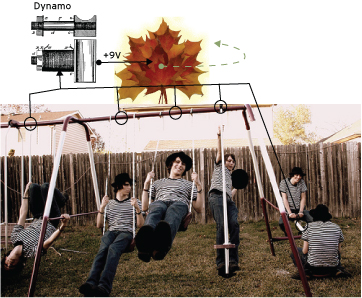
<p><strong>Play-powered park</strong></p>
<span class="mt-enclosure mt-enclosure-image" style="display: inline;"><a href="http://www.confectious.net/thinking/images/01_playpowered_detail.html" onclick="window.open('http://www.confectious.net/thinking/images/01_playpowered_detail.html','popup','width=362,height=298,scrollbars=no,resizable=no,toolbar=no,directories=no,location=no,menubar=no,status=no,left=0,top=0'); return false"><img src="http://www.confectious.net/thinking/images/01_playpowered_detail-thumb-400x329.jpg" width="400" height="329" alt="01_playpowered_detail.jpg"; margin: 0 20px 20px 0;" /></a></span>

<p>Using playground equipment - swings, teeter-totters, see-saws and others - generates friction, which could be used to generate electricity. The Play Powered Park uses children's play to power an animated sculpture (or more than one, depending on the amount of electricity that could be generated). The level of animation in the sculpture visualizes the amount of activity in the park.</p>

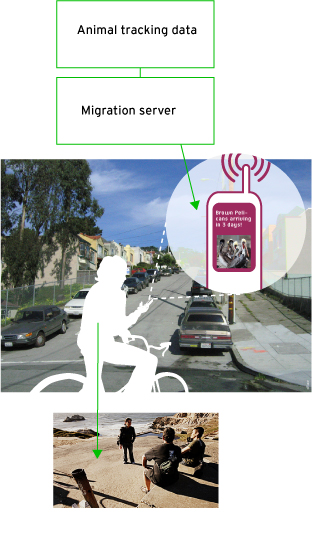
<p><strong>Urban migrations</strong></p>
<span class="mt-enclosure mt-enclosure-image" style="display: inline;"><a href="http://www.confectious.net/thinking/images/04_urbanmigrations_detail.html" onclick="window.open('http://www.confectious.net/thinking/images/04_urbanmigrations_detail.html','popup','width=312,height=553,scrollbars=no,resizable=no,toolbar=no,directories=no,location=no,menubar=no,status=no,left=0,top=0'); return false"><img src="http://www.confectious.net/thinking/images/04_urbanmigrations_detail-thumb-400x708.jpg" width="400" height="708" alt="04_urbanmigrations_detail.jpg"; margin: 0 20px 20px 0;" /></a></span>

<p>(note the 2007-style antenna on the phone!)</p>

<p>San Francisco provides many habitats for migrating animals, especially its lakes and waterfronts. Urban Migrations helps create a sense of anticipation about these seasonal migrations, then helps families plan visits to the parks and open spaces where they can be found. By sending participants messages about the upcoming arrival of animals such as swallows, whales, and geese, it makes the 'velocity' of animal travel across the natural and built landscape more visible.</p>

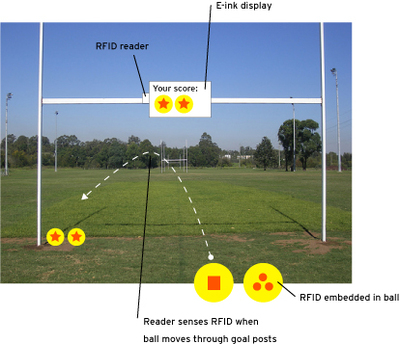
<p><strong>Bounce games</strong></p>
<span class="mt-enclosure mt-enclosure-image" style="display: inline;"><a href="http://www.confectious.net/thinking/images/08_balls_detail.html" onclick="window.open('http://www.confectious.net/thinking/images/08_balls_detail.html','popup','width=414,height=357,scrollbars=no,resizable=no,toolbar=no,directories=no,location=no,menubar=no,status=no,left=0,top=0'); return false"><img src="http://www.confectious.net/thinking/images/08_balls_detail-thumb-400x344.jpg" width="400" height="344" alt="08_balls_detail.jpg"; margin: 0 20px 20px 0;" /></a></span>
 
<p>Augmenting everyday rubber balls and playing field goal posts with proximity sensors gives playing fields and playgrounds the capacity to provide interactive experiences similar to those kids enjoy at home. At the same time, the spaces and balls can still be used for traditional games. Since the balls remain inexpensive, they can be easily replaced.</p>  ]]>
        
    </content>
</entry>

<entry>
    <title>links for 2011-09-08</title>
    <link rel="alternate" type="text/html" href="http://www.confectious.net/thinking/archives/2011/09/links-for-20110-13.html" />
    <id>tag:www.confectious.net,2011:/thinking//1.1011</id>

    <published>2011-09-08T23:32:41Z</published>
    <updated>2011-09-08T23:32:41Z</updated>

    <summary> Beneath The Pavement: Beneath (tags: art greenspace gardens)...</summary>
    <author>
        <name>Liz</name>
        
    </author>
    
        <category term="links" scheme="http://www.sixapart.com/ns/types#category" />
    
    
    <content type="html" xml:lang="en" xml:base="http://www.confectious.net/thinking/">
        <![CDATA[<ul class="delicious"><li>
                <div class="delicious-link"><a href="http://www.futurefarmers.com/beneaththepavement/">Beneath The Pavement: Beneath</a></div>
                
                <div class="delicious-tags">(tags: <a href="http://www.delicious.com/egoodman/art">art</a> <a href="http://www.delicious.com/egoodman/greenspace">greenspace</a> <a href="http://www.delicious.com/egoodman/gardens">gardens</a>)</div>
            </li></ul>]]>
        
    </content>
</entry>

<entry>
    <title>links for 2011-09-03</title>
    <link rel="alternate" type="text/html" href="http://www.confectious.net/thinking/archives/2011/09/links-for-20110-12.html" />
    <id>tag:www.confectious.net,2011:/thinking//1.1009</id>

    <published>2011-09-03T23:12:16Z</published>
    <updated>2011-09-03T23:12:16Z</updated>

    <summary> Adorno and Nose | Vancouver Sun Blogs bus stop posters ask you to whistle while you wait (tags: urban publictransport play)...</summary>
    <author>
        <name>Liz</name>
        
    </author>
    
        <category term="links" scheme="http://www.sixapart.com/ns/types#category" />
    
    
    <content type="html" xml:lang="en" xml:base="http://www.confectious.net/thinking/">
        <![CDATA[<ul class="delicious"><li>
                <div class="delicious-link"><a href="http://blogs.vancouversun.com/2011/09/02/public-art-whistle-while-you-wait-for-the-bus/">Adorno and Nose | Vancouver Sun Blogs</a></div>
                <div class="delicious-extended">bus stop posters ask you to whistle while you wait</div>
                <div class="delicious-tags">(tags: <a href="http://www.delicious.com/egoodman/urban">urban</a> <a href="http://www.delicious.com/egoodman/publictransport">publictransport</a> <a href="http://www.delicious.com/egoodman/play">play</a>)</div>
            </li></ul>]]>
        
    </content>
</entry>

<entry>
    <title>links for 2011-08-29</title>
    <link rel="alternate" type="text/html" href="http://www.confectious.net/thinking/archives/2011/08/links-for-20110-11.html" />
    <id>tag:www.confectious.net,2011:/thinking//1.1007</id>

    <published>2011-08-29T23:02:57Z</published>
    <updated>2011-08-29T23:02:57Z</updated>

    <summary> tesco virtual supermarket in a subway station (tags: southkorea subway shopping consumption mobile)...</summary>
    <author>
        <name>Liz</name>
        
    </author>
    
        <category term="links" scheme="http://www.sixapart.com/ns/types#category" />
    
    
    <content type="html" xml:lang="en" xml:base="http://www.confectious.net/thinking/">
        <![CDATA[<ul class="delicious"><li>
                <div class="delicious-link"><a href="http://www.designboom.com/weblog/cat/16/view/15557/tesco-virtual-supermarket-in-a-subway-station.html">tesco virtual supermarket in a subway station</a></div>
                
                <div class="delicious-tags">(tags: <a href="http://www.delicious.com/egoodman/southkorea">southkorea</a> <a href="http://www.delicious.com/egoodman/subway">subway</a> <a href="http://www.delicious.com/egoodman/shopping">shopping</a> <a href="http://www.delicious.com/egoodman/consumption">consumption</a> <a href="http://www.delicious.com/egoodman/mobile">mobile</a>)</div>
            </li></ul>]]>
        
    </content>
</entry>

<entry>
    <title>links for 2011-08-26</title>
    <link rel="alternate" type="text/html" href="http://www.confectious.net/thinking/archives/2011/08/links-for-20110-10.html" />
    <id>tag:www.confectious.net,2011:/thinking//1.1005</id>

    <published>2011-08-26T23:02:42Z</published>
    <updated>2011-08-26T23:02:42Z</updated>

    <summary><![CDATA[ Next American City » Magazine » D.J. Waldie &quot;Lakewood is not a place of anxious striving. It’s not a place where people worry about where they are going to go next. It’s a place where people worry more about...]]></summary>
    <author>
        <name>Liz</name>
        
    </author>
    
        <category term="links" scheme="http://www.sixapart.com/ns/types#category" />
    
    
    <content type="html" xml:lang="en" xml:base="http://www.confectious.net/thinking/">
        <![CDATA[<ul class="delicious"><li>
                <div class="delicious-link"><a href="http://americancity.org/magazine/article/15-minutes-with-dj-waldie-kaplan/">Next American City » Magazine » D.J. Waldie</a></div>
                <div class="delicious-extended">&quot;Lakewood is not a place of anxious striving. It’s not a place where people worry about where they are going to go next. It’s a place where people worry more about where they might fall down to. The American myth is that all of this was delivered to us by men and women driven by anxious striving. And their anxious striving delivered a place where people who are not anxious strivers can lead ordinary lives. An interesting irony. I don’t know–should the next American city be a place of anxious striving or should it be a place of desire satisfied? Should the next American city be a place where people want to leave, or people want to stay?&quot;</div>
                <div class="delicious-tags">(tags: <a href="http://www.delicious.com/egoodman/urban">urban</a> <a href="http://www.delicious.com/egoodman/suburban">suburban</a>)</div>
            </li></ul>]]>
        
    </content>
</entry>

<entry>
    <title>links for 2011-08-22</title>
    <link rel="alternate" type="text/html" href="http://www.confectious.net/thinking/archives/2011/08/links-for-20110-9.html" />
    <id>tag:www.confectious.net,2011:/thinking//1.1003</id>

    <published>2011-08-22T23:03:08Z</published>
    <updated>2011-08-22T23:03:08Z</updated>

    <summary> On Performativity... | Institute for Public Knowledge (tags: theory performance sts) Design Firm Seeks to Humanize Technology - NYTimes.com (tags: design humanness)...</summary>
    <author>
        <name>Liz</name>
        
    </author>
    
        <category term="links" scheme="http://www.sixapart.com/ns/types#category" />
    
    
    <content type="html" xml:lang="en" xml:base="http://www.confectious.net/thinking/">
        <![CDATA[<ul class="delicious"><li>
                <div class="delicious-link"><a href="http://www.nyu.edu/ipk/events/121">On Performativity... | Institute for Public Knowledge</a></div>
                
                <div class="delicious-tags">(tags: <a href="http://www.delicious.com/egoodman/theory">theory</a> <a href="http://www.delicious.com/egoodman/performance">performance</a> <a href="http://www.delicious.com/egoodman/sts">sts</a>)</div>
            </li><li>
                <div class="delicious-link"><a href="http://www.nytimes.com/2011/08/22/arts/design/design-firm-seeks-to-humanize-technology.html?_r=1">Design Firm Seeks to Humanize Technology - NYTimes.com</a></div>
                
                <div class="delicious-tags">(tags: <a href="http://www.delicious.com/egoodman/design">design</a> <a href="http://www.delicious.com/egoodman/humanness">humanness</a>)</div>
            </li></ul>]]>
        
    </content>
</entry>

<entry>
    <title>links for 2011-08-11</title>
    <link rel="alternate" type="text/html" href="http://www.confectious.net/thinking/archives/2011/08/links-for-20110-8.html" />
    <id>tag:www.confectious.net,2011:/thinking//1.1001</id>

    <published>2011-08-11T23:04:24Z</published>
    <updated>2011-08-11T23:04:24Z</updated>

    <summary> Pocket Gardens Sprout on Paris&#039;s Anti-Parking Posts : TreeHugger (tags: greenspace urban infrastructure parking) 1950s Hospital Of The Future, A Modern Medical Dream Come True (tags: retrofuture video hospital medical)...</summary>
    <author>
        <name>Liz</name>
        
    </author>
    
        <category term="links" scheme="http://www.sixapart.com/ns/types#category" />
    
    
    <content type="html" xml:lang="en" xml:base="http://www.confectious.net/thinking/">
        <![CDATA[<ul class="delicious"><li>
                <div class="delicious-link"><a href="http://www.treehugger.com/files/2011/08/pocket-gardens-sprout-on-paris-anti-parking-posts.php">Pocket Gardens Sprout on Paris&#039;s Anti-Parking Posts : TreeHugger</a></div>
                
                <div class="delicious-tags">(tags: <a href="http://www.delicious.com/egoodman/greenspace">greenspace</a> <a href="http://www.delicious.com/egoodman/urban">urban</a> <a href="http://www.delicious.com/egoodman/infrastructure">infrastructure</a> <a href="http://www.delicious.com/egoodman/parking">parking</a>)</div>
            </li><li>
                <div class="delicious-link"><a href="http://laughingsquid.com/1950s-hospital-of-the-future-a-modern-medical-dream-come-true/">1950s Hospital Of The Future, A Modern Medical Dream Come True</a></div>
                
                <div class="delicious-tags">(tags: <a href="http://www.delicious.com/egoodman/retrofuture">retrofuture</a> <a href="http://www.delicious.com/egoodman/video">video</a> <a href="http://www.delicious.com/egoodman/hospital">hospital</a> <a href="http://www.delicious.com/egoodman/medical">medical</a>)</div>
            </li></ul>]]>
        
    </content>
</entry>

<entry>
    <title>D3 - Branko Lukic: NONOBJECT: The Space Between You and the Object</title>
    <link rel="alternate" type="text/html" href="http://www.confectious.net/thinking/archives/2011/08/d3-branko-lukic.html" />
    <id>tag:www.confectious.net,2011:/thinking//1.1000</id>

    <published>2011-08-05T23:56:25Z</published>
    <updated>2011-08-05T23:57:02Z</updated>

    <summary> Nonobject short history of design we have become a little more object and a little less human pre-design: form follows need then form follows function then human-centered/user-centered design form follows need making fixes a system but didn&apos;t deliver emotional...</summary>
    <author>
        <name>Liz</name>
        
    </author>
    
    <category term="d3" label="d3" scheme="http://www.sixapart.com/ns/types#tag" />
    
    <content type="html" xml:lang="en" xml:base="http://www.confectious.net/thinking/">
        <![CDATA[<p><br />
Nonobject</p>

<p>short history of design<br />
we have become a little more object and a little less human<br />
pre-design:<br />
 form follows need<br />
then<br />
form follows function</p>

<p>then human-centered/user-centered design<br />
form follows need<br />
making fixes<br />
a system<br />
but didn't deliver emotional connection to object</p>

<p>moving to changing the way he understands design<br />
crossover between human and object - within the crossover area lies meaning<br />
design from within<br />
the space of emotions and relationships<br />
ie, a soup spoon that has holes in it to scrape the tongue</p>

<p>"the galaxy is in imbalance"<br />
"the world was always fast, we just didn't have the information about it"</p>

<p>clog vs clarity - but the clog of information isn't necessarily negative<br />
it's just the overload<br />
seeking clarity in order to find relevance<br />
and enable harmony<br />
work life in imbalance<br />
so: harmonious devices to restore balance between work and life<br />
OS is in mechanical age - too much glut of apps and noise<br />
phones should change behavior depending on where you are<br />
what if device knows your needs</p>

<p>diy<br />
perfect design: when you can't see where design starts and engineering stops, and vice versa<br />
for example, pasta.<br />
desire for tailored devices --> diy or curated<br />
print your own phones</p>

<p>mind / aging<br />
formation of mental models - openness to possibility closes down<br />
designing for people to feel at ease in their age<br />
designers need to make things that don't clash with people's rigid expectations</p>

<p>sustainability<br />
designing for objects that live in first and second-hand markets simultaneously<br />
reusability and repurposing</p>

<p>what if we create objects that are subtly different but similar, like pebbles on a beach? that you could find one that relates to you like the "right" pebble on a beach?</p>

<p>photography<br />
- ie, what about a camera that captures what's on the other side of the viewfinder?</p>

<p>when he teaches, asks students not to use Google, as a way to force them onto their own creativity -- then later check outside</p>]]>
        
    </content>
</entry>

<entry>
    <title>D3 - Jody Medich: Making Technology Tactile</title>
    <link rel="alternate" type="text/html" href="http://www.confectious.net/thinking/archives/2011/08/d3-jody-medich.html" />
    <id>tag:www.confectious.net,2011:/thinking//1.999</id>

    <published>2011-08-05T23:24:23Z</published>
    <updated>2011-08-05T23:25:44Z</updated>

    <summary> Descartes&apos; model --&gt; early computers: we only need to control the mind of the computer, not the body controlling the world inside through language beginning in 1980s, move to embodied cognition monkey see, monkey do: mirror neurons that respond...</summary>
    <author>
        <name>Liz</name>
        
    </author>
    
    <category term="d3" label="d3" scheme="http://www.sixapart.com/ns/types#tag" />
    
    <content type="html" xml:lang="en" xml:base="http://www.confectious.net/thinking/">
        <![CDATA[<p><br />
Descartes' model --><br />
early computers: we only need to control the mind of the computer, not the body<br />
controlling the world inside through language<br />
beginning in 1980s, move to embodied cognition<br />
monkey see, monkey do: mirror neurons that respond whether we see it, hear it, or do it<br />
ie, taking notes helps you remember<br />
studies that show that involving bodies helps in problem solving</p>

<p>so, new technologies<br />
- right now we are better at capturing gesture than responding; we rely on visual/video</p>

<p>we are not meeting etiquette expectations<br />
gesture recognition: slashing gestures --> "don't make me be mean"</p>

<p>importance of touch in development<br />
studies suggest direct relationship between tactile senses and emotional responses to relatively unrelated questions</p>

<p>Kicker experiments<br />
- interface of visual reading vs the interface of braille<br />
- braille as a successful visual interface<br />
- Kicker touchscreen braille reader<br />
creating a tactile grid</p>

<p>(created with client, who is in audience now)</p>

<p>"teaching technology to speak human, with a vernacular we can understand</p>

<p>developed for blind children learning through digital textbooks, especially math</p>]]>
        
    </content>
</entry>

<entry>
    <title>D3 - Leila Takayama: Personal Robotic Devices </title>
    <link rel="alternate" type="text/html" href="http://www.confectious.net/thinking/archives/2011/08/d3-leila-takaya.html" />
    <id>tag:www.confectious.net,2011:/thinking//1.998</id>

    <published>2011-08-05T23:21:35Z</published>
    <updated>2011-08-05T23:22:31Z</updated>

    <summary> &quot;robots are really fun to work on and my God we need help&quot; stress testing robots so that the parts can survive buggy code robots for open-source coding working on redesign of robot to make it more friendly for...</summary>
    <author>
        <name>Liz</name>
        
    </author>
    
    <category term="d3" label="d3" scheme="http://www.sixapart.com/ns/types#tag" />
    
    <content type="html" xml:lang="en" xml:base="http://www.confectious.net/thinking/">
        <![CDATA[<p><br />
"robots are really fun to work on and my God we need help"</p>

<p>stress testing robots so that the parts can survive buggy code</p>

<p>robots for open-source coding<br />
working on redesign of robot to make it more friendly for scientific research with ordinary people who might be freaked out by a head that "looks like a tarantula"</p>

<p>"the head is small because robots aren't so smart yet and we don't want them to look too smart"</p>

<p>collaboration with Henry Evans, a quadriplegic who drives the robot to do mundane things like scratching his face and shave himself by using his eyes to shave the robot</p>

<p>skunkworks "skype on wheels" for teleworking</p>

<p>turtle robot - uses kinect</p>

<p>personal robotic devices as a product category<br />
- in a sense, your HVAC system and your washing machine are robots.</p>

<p>challenge 1: design agentic objects<br />
lesson 1: underpromise and overdeliver to avoid disappointment<br />
lesson 2: consider imitating non-humans in designing interactions</p>

<p>question: how do people make sense of behaviors?<br />
video prototyping forethought and success with a Pixar animator<br />
then showed the video online and did a questionnaire on reactions<br />
also got a Pixar sound designer to do robot non-verbal sounds</p>

<p>where is the brain when the computer brain is in the cloud?<br />
lesson: physical distantiation of disagreement so that voice is in a different place than the body</p>

<p>challenge 2: getting robots to be more [invisible in use]<br />
once again, Heidegger<br />
Gibson's ecological psychology and cars</p>

<p>the interesting space for robotic design are robots that seem like agents, and robots that disappear into use.<br />
for invisibility in use:<br />
analogy: equestrian relationships of people and horses</p>

<p>q: wally?<br />
a: we do get inspiration from that</p>]]>
        
    </content>
</entry>

<entry>
    <title>D3 - Cori Schauer: Knobs, Buttons, &amp; Dials: A Brief History of NASA Johnson Space Center&apos;s Mission Control Center</title>
    <link rel="alternate" type="text/html" href="http://www.confectious.net/thinking/archives/2011/08/d3-cori-schauer.html" />
    <id>tag:www.confectious.net,2011:/thinking//1.997</id>

    <published>2011-08-05T18:52:47Z</published>
    <updated>2011-08-05T18:53:32Z</updated>

    <summary>(a note: all facts&apos; are NASAs, all opinions her own) (the photos are particularly important for this one -- watch the talk if you&apos;re really interested) for Molly: first slide is a picture of pneumatic tubes for mail, used in...</summary>
    <author>
        <name>Liz</name>
        
    </author>
    
    <category term="d3" label="d3" scheme="http://www.sixapart.com/ns/types#tag" />
    
    <content type="html" xml:lang="en" xml:base="http://www.confectious.net/thinking/">
        <![CDATA[<p>(a note: all facts' are NASAs, all opinions her own)<br />
(the photos are particularly important for this one -- watch the talk if you're really interested)</p>

<p>for Molly: first slide is a picture of pneumatic tubes for mail, used in 1965!</p>

<p>mostly same room and equipment supported 3 vehicles over 34 years</p>

<p>innovation and change in mission control are "kinda not good words"<br />
cool thing #1<br />
"dial a display" in the control room<br />
a TV that can dial into any display you want, using something that looks like a combination lock -- from a mainframe!<br />
so you're dialing into a mainframe to change your display<br />
hardwiring new displays is faster than implementing comparable software upgrades today, because everything needs to be certified</p>

<p>cool thing #2<br />
"the loops"<br />
look like ear buds -- a series of channels that you can listen to, so you can listen in to every conversation going on<br />
at first it's madness, because you're listening to a "cacophony"<br />
so you could be listening to 13 channels at once<br />
"things don't change in NASA interaction design because people could die" -- because "you know it's going to work when you need it to work"<br />
"risk is a pretty bad word"</p>

<p>cool thing #3<br />
"station" -- the space station doesn't have a manual<br />
it doesn't work like they thought it would -- 98% troubleshooting<br />
so that means hacks become SOP<br />
"you can design for one thing, but you usually get something else" ... especially when you build stuff in space<br />
using cardboard models of the station to troubleshoot complex changes</p>

<p>debatable cool thing #4<br />
"failure is not an option"<br />
flight control culture created by one man<br />
"to always be aware that suddenly and unexpectedly we may find ourselves in a role where our performance has ultimate consequences."<br />
flight control, you can't forget, are friends with astronauts<br />
people work crappy hours in tough environments making hard decisions every day<br />
spaceflight is not routine, even though it seems routine. everything is risky.</p>

<p>the bad thing is: there's a lot of redundancy<br />
"it's more satisfying to punch buttons"</p>

<p>What's next for manned space flight after the retirement of the shuttle?<br />
outside commercial partners will provide vehicles<br />
wow! a research project being talked  looking at what it would mean to send astronauts to live beyond low earth orbit</p>

<p>q: nasa's goals in hiring an ethnographer?<br />
Only a few. Cori joined as part of a software dev team. She is the lone ethnographer with designers and engineers.</p>

<p>q: the loops?<br />
Very restrictive. Not even allowed to use outside IM -- NASA rolls its own. Although in the background there are TVs.</p>

<p>q: Do the audio channels get transcribed into text?<br />
a: No. The "black box" has everything recorded by date and timestamp, so you can go back and transcribe if you have to.</p>

<p>q: will commercial partners just supply equipment?<br />
a: up for debate.</p>

<p>q: how long before we lose this experience?<br />
a: most flight controllers are already laid off. but the station is still flying.</p>

<p>"the hard things for humans in space is, do you trust the computer to be right?"</p>]]>
        
    </content>
</entry>

<entry>
    <title>D3 - Liz Bacon: Extraordinary Design Considerations for Medical Devices</title>
    <link rel="alternate" type="text/html" href="http://www.confectious.net/thinking/archives/2011/08/d3-liz-bacon-ex.html" />
    <id>tag:www.confectious.net,2011:/thinking//1.996</id>

    <published>2011-08-05T18:25:53Z</published>
    <updated>2011-08-05T18:26:37Z</updated>

    <summary>(hard to summarize) emphasis on regulatory landscape communication is vital documentation is king research must be specified in writing for regulatory compliance -- so lean processes and guerilla work is less practical luckily, there are professionals dedicated to risk management...</summary>
    <author>
        <name>Liz</name>
        
    </author>
    
    <category term="d3" label="d3" scheme="http://www.sixapart.com/ns/types#tag" />
    
    <content type="html" xml:lang="en" xml:base="http://www.confectious.net/thinking/">
        <![CDATA[<p>(hard to summarize)<br />
emphasis on regulatory landscape<br />
communication is vital<br />
documentation is king<br />
research must be specified in writing for regulatory compliance -- so lean processes and guerilla work is less practical<br />
luckily, there are professionals dedicated to risk management<br />
product requirements *must* be maintained throughout process to match current designs because that's what's reviewed by regulators. requirements must be testable and traceable.<br />
since regulations underspecify components of "design phase," you need to fill in your own methods that still conform with the regs<br />
(also, use the phrase contextual inquiry when you do initial research, since that's the phrase that's in the standards!)<br />
need to think about maintenance of prototypes in design documentation processes<br />
usability testing - classic, moderated form and need to define clear objectives from research so that you know what you're being judged against<br />
so user research is a very good investment<br />
-- long shelflife for personas because of power of roles in medical domain, since people live by checklists and standards<br />
and strength to defining design patterns so that you can leverage institutionalization (this also includes style guides)<br />
design to avoid problems, rather than mitigate them - make errors impossible.<br />
so systems and QA people are your friends, since there's so much to do -- and because regulatory agencies prefer designers don't do their own usability tests<br />
challenges<br />
- few design agencies have regulatory know-how, but it's not hard to get<br />
- need to recognize that you need more documentation, and support it for longer times<br />
- get involved in standards-making<br />
- but please get involved! this is a field in which bad design can kill people.</p>]]>
        
    </content>
</entry>

<entry>
    <title>links for 2011-07-25</title>
    <link rel="alternate" type="text/html" href="http://www.confectious.net/thinking/archives/2011/07/links-for-20110-7.html" />
    <id>tag:www.confectious.net,2011:/thinking//1.994</id>

    <published>2011-07-25T23:08:58Z</published>
    <updated>2011-07-25T23:08:58Z</updated>

    <summary><![CDATA[ Kevin Slavin: Those algorithms that govern our lives | Lift conference, what can the future do for you? &quot;Digital technologies and on-line platforms are essential to the way we work and live. Interestingly, they are defined by algorithms which...]]></summary>
    <author>
        <name>Liz</name>
        
    </author>
    
        <category term="links" scheme="http://www.sixapart.com/ns/types#category" />
    
    
    <content type="html" xml:lang="en" xml:base="http://www.confectious.net/thinking/">
        <![CDATA[<ul class="delicious"><li>
                <div class="delicious-link"><a href="http://liftconference.com/lift11/program/talk/kevin-slavin-those-algorithms-govern-our-lives">Kevin Slavin: Those algorithms that govern our lives | Lift conference, what can the future do for you?</a></div>
                <div class="delicious-extended">&quot;Digital technologies and on-line platforms are essential to the way we work and live. Interestingly, they are defined by algorithms which are not neutral. Kevin discusses how they define new social norms and how our culture is affected by the possibilities embedded in the software we use.&quot;</div>
                <div class="delicious-tags">(tags: <a href="http://www.delicious.com/egoodman/algorithms">algorithms</a>)</div>
            </li></ul>]]>
        
    </content>
</entry>

</feed>