| Elizabeth Goodman { // ITP 2001 - 2002 // Introduction to Physical Computing // The Nervous Jello |
concept // how it works // technical specs // what next? |
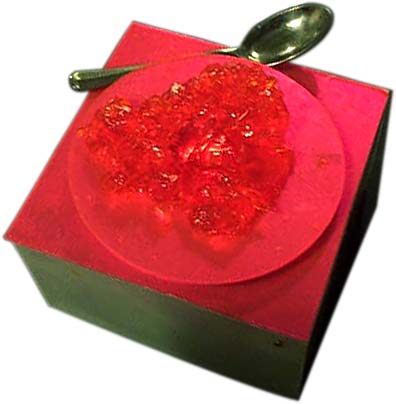 The Story of Jello The Nervous Jello began with a late-night trip to a corner deli which displayed large trays of orange and red jello in a glass case. As the guy at the counter reached for various salads and meats, the Jello quivered and jiggled with every movement. It occurred to me then that Jello is actually made of water mixed with gelatin and various solutes, and as such is should be conductive. The idea of a jiggly, edible, see-through conductive substance proved irresistible and I immediately made a Jello switch, with the intent to use it as an interface for music or lighting. It seemed so intuitively perfect – the Jello wobbles and thus should make a wobbly noise. I never got around to making the Jello musical instrument, but inquiries into squishy conductive substances led me to my midterm project, which used conductive gels. And so the Jello waited for the right moment. I initially did not intend to go back to the Jello switch – I wanted to do something bigger, something more serious, more intellectual. But none of my other ideas seemed convincing or even workable. And everytime I went for late-night coffee, I saw the Jello... After weeks of vacillation, I finally went back to the Jello. My initial sketches were, however, much less silly and more overtly creepy, involving biological metaphors like ears, nerve cells, and mouths. But the Jello really did have a mind of its own; it steadfastly refused to be intellectualized. What I came to was a return, in fact, to the conceit of previous projects: that I was playing Frankenstein in making an apparently living organism that would respond in seemingly self-motivated ways to outside stimuli. If Jello were alive, what kind of an animal would it be? I decided to go back to the basics and treat the qualities of Jello as seriously as I would treat any sculptural material. And as any five-year-old knows, there are three important things about Jello: it jiggles, it refracts light, and it’s tasty. Thus, any object I made with Jello would have to possess these qualities: it would have to be somehow ‘alive’; it would have to somehow produce interaction through jiggling; it should use light; and it should be edible. To those constraints, I added two others in order to preserve the illusion of my Jello toy being a small, autonomous organism: the object should be completely contained within a small box and it should be battery-powered. With those parameters, the Jello interaction was clear: it needed to react in some way to being eaten. Well, if someone were trying to eat me, I would scream. Clearly, my Jello needed to scream as it was being devoured. Not wanting to introduce extraneous elements like MIDI or Director to what should be a small, neat little package, I started thinking about generating sound with the BX, and returned to my original idea of a Jello ‘ear’ that ‘heard’ physical vibrations and output matching sound waves to a speaker as frequencies. The Jello would actually produce sounds that matched the vibrations of its jiggle. It also seemed appropriate to match the volume of the sound to the amount of Jello eaten, so that the Jello ‘scream’ would gradually get weaker and die as it disappeared from the plate. So with those goals in mind, I needed to make a device that could tell when it was touched, would twitch in response, and could very sensitively sense vibration. } |