May 2005 Archives

Chicago crime comment spree

| | TrackBacks (1)

There was a bit of a discussion on geowanking over the past couple of days about the lovely Chicago Crime site. There was a brief interchange about the value of information design when comparing Chicago Crime and the site from which it draws data – the Chicago Police Department's official Citizen iCAM website. The question is, did the pretty Google map interface make a difference?

The site got slashdotted, and that was the end of checking it out for a bit. Now it's back up. What was interesting about the Slashdottery, however, was the one comment from a Chicago resident who actually used the iCAM data:

When I was shopping for condos in Chicago a few years ago, I looked at the Citizen ICAM [12.17.79.6] site (forgive the slashdotting...), which actually has a somewhat better interface for search, in my opinion. It may not look as slick as google, but it does allow you to look over a range of dates, and the map icons identify the type of crime... It let me see that one prospective condo was right in a corner of fairly low crime, bordered by much higher crime. I could have guessed that visiting the neighborhood, but it was nice to see somewhat empirically.

So let's take a look at both maps:
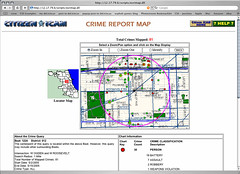
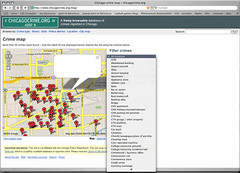
chicago-icam chicago-crime
Citizen iCAM, ChicagoCrime.org

Most mapping interfaces assume that the points being mapped (what Mappoint intrusively calls "pushpins") are roughly equivalent. When you think that mapping is about finding the nearest ATM, or dry cleaners, or whatever, the ATMs pinpointed on the map don't need to be represented by different icons. Hence Google's gruesome red balloons, or the loathsome Mapquest red stars, or the horrific Mappoint pushpins.

You can alter the Mappoint pushpins to use different icons. And Worldkit now offers different icon choices as well. But very, very few people ever bother to change the defaults.

So one huge problem, as the case of Chicago crime shows, is that the use of default map icons can create a misleading visual equivalency. If you're looking to buy an apartment, it matters a lot whether those red balloons on the map represent assault and battery, or car theft.

Here's where a little bit of research on why and how people visit the iCAM site would have come in handy.

Another problem, as the commenter mentioned, is the use of time as a search parameter. Again, if you're looking for an apartment, you probably might want to know how frequently crimes occur within a given area. As I know from persistent lurking on the geowankers list, it's pretty hard to work out how to record and represent the passage of time as it relates to spatial location. Yet that's exactly the sort of information people end up wanting.

Another nice trick on the iCAM site, I think, is the purple circle indicating the distance covered by the map. In the case of the map above, the circle's radius is one mile. Again, that's the sort of thing that a resident (or someone just moving to Chicago) might find useful. And it's not something I see on too many online maps.

I find it ironic that the visual design of ChicagoCrime.org beats the pants off the iCAM site. But the police officers who built iCAM understood something that the web designer of ChicagoCrime didn't*: what information matters most to people on the ground.

Google Maps has raised awareness of the potential for improvement in the typical pan-n-zoom experience. But web mapping applications still seem to be at the same level as web design in 1996: waiting for the novelty to wear off so that some design principles can be worked out.

*I'm beating up on ChicagoCrime.org more than I think is necessarily fair. When you hack a new API that's not really intended for outside adaptation, you kind of have to roll with what it offers by way of functionality. Nevertheless, I think the critique stands as a fair one of the kind of default assumptions many people make when they start working with maps.

beyond reuse

| | TrackBacks (0)

The NYT Home and Garden section - of all places - had a really interesting article on Julia Christensen, an artist who travels around the US studying the reuse of abandoned big box stores.

There are a couple of points that resonated with me -

1) Architecturally uppity Americans may well have to get used to the reassuring cultural connotations of big box stores for many people if they want to integrate cultural institutions into everyday life.

"The generation we live in today, when they look at an old-fashioned steepled church, there's a fascination but also a little bit of intimidation," said Bob Corry, an associate pastor. "If we dolled up our building, we'd be pushing away an element of our community that desperately needs to be welcomed."

Hence, the Orange Lounge, which is the Orange County Museum of Art's branch location at the South Coast Plaza Mall. Yeah, the mall. The Orange Lounge doesn't fully take advantage of the mall vernacular to reach out to passing shoppers, but I still love the idea.

2) Also, yet another reminder about the difference between the database and the search engine

Ms. Christensen says she will return to Calvary Chapel in a few weeks to record the latest stages of its rebirth as a place of worship. But first she will visit sites in Kentucky, Missouri, Kansas, Texas and Alabama. "I could be this database that sits here and never moves, but it's been so important to me to go out and investigate," she said. "There's nothing on the Web site I haven't seen with my own eyes."

3) And finally, once again, the importance of being precise about our vocabulary

Julia Christensen talks about the "reuse" of big box stores, but to me it looks much more like "recovery." Or maybe "recuperation." It's not that the big box stores are being taken other by other huge chains. What she's chronicling is transformation, not repetition. It's worth remembering that big empty boxes, no matter how ugly they look from the outside, can be endlessly transformed within.

getting physical

| | TrackBacks (0)

My workshop proposal (with Brooke Foucault and Sunny Consolvo) was accepted to Ubicomp 2005. Hooray! It's in Tokyo. I've never been to Tokyo before. I'm very excited.

Ubicomp is an annual conference for people engaged in the wild pursuit of 'invisible computing' - that is, computation so intimately bound up in everyday life that it ceases to feel like 'technology' and effectively disappears. While previously a forum for engineers, Ubicomp is increasingly attended by a diverse lot (mostly academic, though) of social scientists and designers.

The workshop is called "Monitoring, measuring, and motivating exercise: ubiquitous computing to support physical fitness". It addresses:


the role of ubiquitous computing in promoting physical activity. Discussion topics include: mobile and wearable devices for physically active people, culturally dependent definitions of “fitness” and “activity,” why and how we design motivational interfaces, sensors and other technologies that monitor and assess physical activity, as well as the legal and ethical concerns raised by potentially combining persuasive computing and biometric monitoring.

I'm also planning to include a lot of discussion on mobility and physical gaming, since that's what I've been interested in for a while. There will also be some playing around with pedometers and possibly some exploration of the surrounding neighborhood.

I myself find our workshop title somewhat daunting. But it adequately represents each author's interests, and sounds appropriately academic. While very proud of the careful wording of the title and the proposal, I'm inviting all those reading this blog to read it as:

It Wouldn't Hurt To Get Out More: Technologies That Get You Off That Chair

Thanks. And please do feel free to email me with any questions or comments if you'd like to submit.

About this Archive

This page is an archive of entries from May 2005 listed from newest to oldest.

April 2005 is the previous archive.

June 2005 is the next archive.

Find recent content on the main index or look in the archives to find all content.

Pages

  • /thinking
  • projects
Creative Commons License
This weblog is licensed under a Creative Commons License.