March 2008 Archives

In the United States a man builds a house in which to spend his old age, and he sells it before the roof is on; he plants a garden and lets it just as the trees are coming into bearing; he brings a field into tillage and leaves other men to gather the crops; he embraces a profession and gives it up; he settles in a place, which he soon afterwards leaves to carry his changeable longings elsewhere.
- Alexis de Toqueville, quoted in Bourgeois Nightmares: Suburbia, 1870-1930 by Robert Fogelson. The chapter, by the by, is called "Fears of Almost Everyone and Everything."

Changeable longings is a beautiful phrase, isn't it? It describes just how I feel right now: in the mood to go somewhere else, but I'm not sure where.

Public smog

| | Comments (0) | TrackBacks (0)

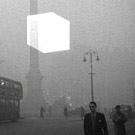
London Smog graphic for Public Smog art project

Just went to opening of VAPOR, an exhibit at Southern Exposure on pollution. One of my favorite projects there was Public Smog:

PUBLIC SMOG is a park in the atmosphere that fluctuates in location and scale. The park is constructed through financial, legal, or political activities that open it for public use.
Activities to create Public Smog have included purchasing and retiring emission offsets in regulated emissions markets, making them inaccessible to polluting industries.
When Public Smog is built through this process, it exists in the unfixed public airspace above the region where offsets are purchased and withheld from use. The park’s size varies, reflecting the amount of emissions allowances purchased and the length of contract, compounded by seasonal fluctuations in air quality.

One of the things I like about Public Smog is that, like PARK(ing), it invents a new kind of temporary 'public park' through entry into a market.
In Public Smog, the market is emission trading of greenhouse gases; in PARK(ing) it's the rate of payment for parking meters. They are tied to the forces (like polluting activities, or dependence on cars) that they attack. In that sense, they also gently play with the unrealistic idea that parks are spaces of 'nature' (sorry, have to use the scare quotes) - somehow separate from commercial spaces and processes that shape the rest of human settlements.


I've been doing a lot of background research on personal sensing applications and devices. Usually, they involve hooking up some kind of sensor to a network-enabled device (often a mobile phone) and uploading data to a shared repository. Sometimes the sensor is embedded in the phone (like a noise sensor); sometimes the sensor is an external device that has to be manually hooked up (usually through an intervening device like an Arduino). This model is a little different.

E. Agapie, G. Chen, D. Houston, E. Howard, J. Kim, M. Y. Mun, A. Mondschein, S. Reddy, R. Rosario, J. Ryder, A. Steiner, J. Burke, E. Estrin, M. Hansen, M. Rahimi, “Seeing Our Signals: Combining location traces and web-based models for personal discovery” In Proceedings of the 9th IEEE Workshop on Mobile Computing Systems and Applications (HotMobile 2008), Napa Valley, CA, February 25-26, 2008.

It proposes combining GPS traces of human movement with available online data. The user does not carry any sensors (except GPS). Instead, the point is to "index our life into other available datasets about the world around us."

What I also find interesting about this paper is its demonstration of a new set of beliefs about environmentalism: that areas of "interaction between individuals and
the environment" include "transportation mode choice, overall carbon footprint, and opportunities for healthy eating." As recently as three years ago, eating probably wouldn't have been included on that list.
Pages

  • /thinking
  • projects

Archives