Many urban games/pastimes - like hopscotch - revolve around
the demarcation of space through markings. Players create
ad-hoc gameboards by using asphalt as canvas.
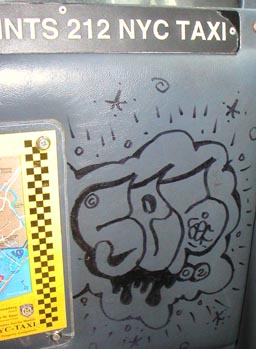
The more adult form of this is tagging, where taggers use
the entire city as a canvas for their ambitions. As one ex-tagger
said in an interview: "You want to be like Madison Avenue
ads - everywhere." We can look at tagging as a prototypical
urban sport of controlling turf through self-identification.
Controlling turf is a powerful motive behind many games -
Monopoly being the most widely played. What would it mean
to turn the entire city into a Monopoly board? How would players
establish their ownership of certain spaces without the physical
intervention of the tag?
For us, the answer was action + community. Tagging is, of
course, an illegal action. The tag is the extremely
visible record of a series of gestures performed
more or less secretively. Tagging is also, in part, aimed
at impressing other taggers. The taggers wants to be "everywhere"
- but also want to let other taggers know how cool they are
through their artistic signatures.
In our case, the "tag" is a public set of actions
that make the game (and the community) visible in an otherwise
"normal" urban space. Just as taggers perform in
part for their peers, so do our players submit photos of their
stupid stunts to the community as proof that they were brave
enough to make asses of themselves in public. Their reward?
The respect of their peers and their dominance over a piece
of an ever-changing gameboard. The more stunts performed in
the more locations, the more visible, and the more dominant,
an individual or group becomes.
>> next
above: When your tag is in a taxi, it goes everywhere.
|