August 2008 Archives
Fred Turner: The Politics of Design in the American Counterculture


Seeing the return of 1960s words: "virtual community" "personal computer" "virtual frontier" - what can we learn from the geodesic dome and the Whole Earth Catalog
ANNOUNCING THE THIRD INTERNATIONAL CONFERENCE ON TANGIBLE AND EMBEDDED
INTERACTION
http://tei-conf.org
----------------------------------------------------------------------
DATES AND LOCATION
Paper submission deadline 31st Oct 08
Reviews due 27th Nov 08
Author notification deadline 30th Nov 08
Camera-ready copy deadline 15th Dec 08
Early registration deadline 7th Jan 09
Conference dates February 16-18, 2009, Cambridge, UK
----------------------------------------------------------------------
Computing is progressively moving beyond the desktop into new physical
and social contexts. One key area of innovation has been around
tangible computing, which pushes the user interface beyond the digital
into the physical world. This includes work on tangible interfaces,
graspable interfaces, physical computing, and interactive surfaces. A
closely related topic is that of embedded interaction where the
everyday objects and environments we interact with are computationally
augmented in new ways. Designing such systems requires
interdisciplinary thinking. Their creation must not only encompass
software, electronics, and mechanics, but also the system's physical
form and behaviour, as well as its social impacts.
After the big success of TEI'07 and TEI'08 we are pleased to announce
the third international conference dedicated to presenting the latest
results in tangible and embedded interaction. We invite submissions of
work addressing HCI issues, design, user experience, tools and
technologies, as well as interactive art in the broad area of tangible
computing and embedded interactive systems. The intimate size of this
single-track conference provides a unique forum for exchange of ideas
through talks, interactive exhibits, demos, posters, art installations
and performances. All accepted submissions will be included in the
conference proceedings, which will be published through the ACM
Digital Library.
----------------------------------------------------------------------
TOPICS FOR SUBMISSION
Authors are invited to submit high-quality original work to advance
the field. Appropriate topics include but are not limited to:
* Examples of novel tangible interfaces or embedded interactive systems
* Case studies and evaluations of working deployments
* Relation of tangible and embedded interaction to other paradigms
* Programming paradigms and tools, toolkits, software architectures
* Novel enabling technologies
* Interactive uses of sensors and actuators, and electronics and
mechatronics
* Design guidelines and methods
* Applied design in the form of concept sketches, prototypes and products
* Novel applications
* Theoretical foundations, frameworks, and concepts
* Philosophical, ethical and social implications
* Usability
* Provocative design work and interactive art
----------------------------------------------------------------------
submission details in extended entry
Social Networking and Its Sites: Discovering/Uncovering Values
Values in Open Video
Infrastructure and values
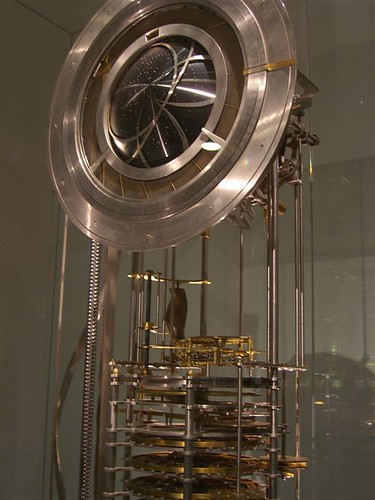
clock of the long now
infrastructure exists in a long now and moves very slowly
About the NSF
Values at play
New Games movement of 1970s
How we play the game may be more important than we imagine, for it signified nothing less than our way of being in the world" (George Leonard, Ultimate Athlete)
tools and technologies of commercial games have proliferated out, and are being used to understand complex sociopolitical issues
wrapping game mechanics in existing situation creates empathy
procedural rhetoric is the art of persuasion through rule-based representations and interactions rather than the spoken word, writing, images or moving pictures (Ian Bogost)
but games create meaning at multiple levels - not just rules
they create meaning in action, so you can't just "bake in" meaning - you have to embed the values you think they want, but they may or may not emerge in play - you have to test it
understanding formal elements
the least understood part of games - people usually think about "running around a screen"
but how do you get to that?
games are for players - not for designers
how is the interaction between the players organized?
one person against a system?
multiple players?
ex: Ruth Kettler's three-person chess game
what goals structure the play
what rules guide or limit the players' actions?
we constrain action so play is possible
how does the play proceed? (can be like rules)
actions of play
what resources are available to players to accomplish their goals
resources: anything that is scarce and has utility
what do we provide? take away?
how things are given, traded, emerge, fade away
what are the boundaries of the experience?
Huizinga's magic circle, etc
how will it end?
Fullerton: games must be uncertain in tension with striving for closure
Flanagan: well, Salen and Zimmerman def of play includes win state and lose state
the core mechanic is the essential nugget of game activity, the mechanism through which players make meaningful choice and arrive at a meaninful play experience (Salen and Zimmerman, Rules of Play)
the coalescing of rules into experience
classic strategy games - like go
fairness
positing the rational universe
strategy can overwhelm numbers
modern strategy games
modeling modern warfare
hidden information
multiplayer
first person shooters
individual
hostile world
direct combat is only mode of expression
honorable war
how could a game be designed to simulate a social conflict, psychological conflict, or interpersonal conflict? These are truly tough design challenges...part of the challenge lies in the fact that simulations require radical simplification and stylization. (Salen & Zimmerman)
phases
discovery
(definitional activity): translation
operationalization into action/decision
Birdhouses have recently been a helpful metaphor for me in thinking through how people create interfaces to plants, animals, and micro-ecologies. In looking for pictures of various kinds of birdhouses, I realized that birdhouses themselves come in an amazing variety of forms and shapes, and are a kind of touchstone for design over the years - from high design to DIY kits.
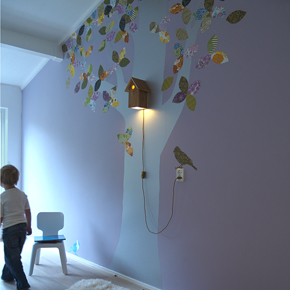
romp sells a wall decoration by Inke Heiland, which they accessorize with a birdhouse lamp in this picture.

If you're a cheapskate, Creative Kids Stuff sells a simple recycled cardboard birdhouse, which, paired with an LED light, would make a great lamp.

Droog Design sells its own bird feeder, of course. I find it a bit...impractical. Maybe it's designed for miniature birds? This one points to what I like best about the tools and artifacts of gardens: their design is often very tied to highly local needs (gopher wire, for example) because both humans and non-humans will be working with it. In this case, I don't think many of California's birds could fit underneath that roof.

This one comes from a less famous source, and I find that I like it better. The shape references bird eggs.
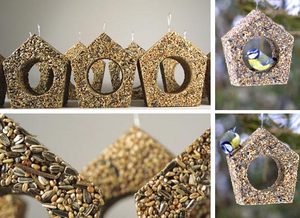
Through Inhabitat, I also found Atelier Oi's Edible Birdhouse, which seems...logical.
All of this birdhousing makes me want to design my own kit - using Pepakura I could probably come up with something easy to build...maybe out of recycled vinyl?

