full of young people watching TV, if you believe Vodafone.
Oh yeah, and in the future there's a lot of Flash.
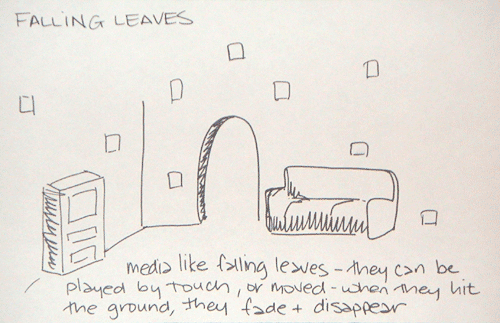
It's got the familiar complement of bracelet, pendant, and sunglasses wearables, although Digital Wallpaper, as always, strikes me as a really liveable idea if programmed correctly*. I love the ways our visions of the future never quite see the real changes to come: who could imagine now a world in which female military officers wear miniskirts? We're always crucially wrong on those small details -- and the larger cultural changes that create them.
But one vision of the future seems to remain constant: the idea that somehow computers will magically read our hearts and minds, then respond appropriately. Scott points this out in a great post on an article by Roy Want in Scientific American: "Weiser['s]... bold vision of 'ubiquitous computing': small computers would be embedded in everyday objects all around us and, using wireless connections, would respond to our presence, desires and needs without being actively manipulated." if by "active manipulation", he means "conscious operation of an interface", then that's all good and fine. but i suspect the article's audience will interpret it to mean that ubicomp won't have an interface and will respond to us automagically. using what? telepathy? interactional invisibility does indeed involve active manipulation, in the sense that users will physically and socially manipulate the world to achieve ends aided by computers. but they'll be thinking not about the manipulated tool, but about the action or activity the manipulation effects.
The Scientific American article is headed "Automating Everything," and the Vodafone concepts pick up that ball and run with it. My favorite "automate everything" candidate is the "Emergency service" communicator, which can monitor the emotional state of the user and detect distress or fear. Faced with a threatening situation, the service can trigger an audible alarm or automatically contact the appropriate authorities. There's a lot unstated in this scenario of use, so I'm going to try to give Vodafone the benefit of the doubt. Let's hope the user has to deliberately arm the device before it calls the cops. Let's hope there's some good feedback to the user and some manual overrides. Because otherwise, I'd really hate to see what would happen if I was late for work, ran a block after the bus, yelled for the driver to stop, then finally gave up and started to cry.
This is a challenge that the affective AI people have taken on as well. I can't say as I have much hope for that project either. As Scott says, life is lived in the confounds; it consists both of patterns (which supposedly "the system" will learn and act on) and of exceptions to those patterns. In the future, as in the past, people will continue to misunderstand me, I will continue to misunderstand myself, and we'll all stumble forwards together, often failing -- but sometimes succeeding beyond our wildest hopes. A computer emergency system, like a can of Mace or a .45 in the back pocket, can be a reassuring thought in a dark street after midnight. But as with the gun, just because something sounds reassuring doesn't mean it makes you safer.
*cf last year's sharing personal media ideation. Or thinking about Equator's tablecloth











Leave a comment