-
"First, services may be made mobile–ready, as with special mobile interfaces for library services, alerting services, and so on. Second, mobilization continues the restructuring of services, organizations and attention that networking has brought about. Think here of how to socialize and personalize services; how to adapt to collection and service use which spans personal, institutional, and cloud environments; how to position and promote the library ‘brand’ as services become atomized and less ‘visible’ on the network; and more complex questions about what best to do locally and what to source with collaborative arrangements or third parties."
-
"I saw you standing all alone in the electrostatic rain I thought at last I'd found a situation you can't explain with GPS you know it's all just a matter of degrees your happiness won't find you underneath that canopy of trees if the green grass is 6 the soybeans are 7 the junebugs are 8 the weeds and thistles are 11 and if the 1s just hold their place the 0s make a smiley face when they come floating down from the heavens" - from Andrew Bird, "Masterfade"
January 2009 Archives
-
"I saw you standing all alone in the electrostatic rain I thought at last I'd found a situation you can't explain with GPS you know it's all just a matter of degrees your happiness won't find you underneath that canopy of trees if the green grass is 6 the soybeans are 7 the junebugs are 8 the weeds and thistles are 11 and if the 1s just hold their place the 0s make a smiley face when they come floating down from the heavens" - from Andrew Bird, "Masterfade"
-
Paraphrasing Matt Jones: "Among his other golden nuggets were: 'I hope someone comes up with the Nintendo Wii for Apple's PlayStation', a friend who'd described switching on GPS as 'switching the sky on' and a quote by Stanford professor Donald Knuth who observed that: 'Email is a wonderful thing for people whose role in life is to be on top of things. But not for me; my role is to be on the bottom of things.'"
-
"GeoCommons delivers visual analytics through maps; enabling non-technical professionals to view multiple datasets, draw conclusions, make decisions and solve problems without traditional GIS overhead."
-
Printable Garden Journal Pages
-
Tools & Methods to design for emotion
-
surprisingly delicious, and beautiful with all the different shades of green in the leek roots and tops.
-
machinima links
-
"All kinds of mobile media can be used to register and track behavior, varying from spatial use (where was I last week) to consumption patterns (what did I buy, what was I reading, listening to on my iPod etc). I will call this Google Earth Urbanism: the possibility to leave one’s tracks and markup actual space. These track records can be analyzed on aggregate, or used on an individual base. They can be used as the base for what one could call Long Tail Urbanism: reference to potential sites or persons of interest through ‘discovery algorithms’. "
-
Remember life before e-mails and cell phones?
The hi-tech devices were supposed to help simplify our lives and give our brains a break by storing phone numbers and other important information.
But the real impact of all that technology is that we're now being overloaded with information and we may be actually losing our memory!

An open project between BugLabs and IDEO, this deep-dive exploration of the BUGbase UI is focused on re-envisioning the BUGbase interface with an eye toward integrating new display and input technologies.The outcome of these explorations will feel less like a finished product and more like a concept car. And like any successful concept car, we hope these provocations will not only help us gauge users' interests, but will spur constructive discourse and inform future design, engineering, and business decisions.
BugLabs' commitment to openness presents a unique and exciting opportunity for us to be as inclusive about the design process as possible. For this quick two week collaboration, we will be conceptualizing new interface paradigms, designing new tangible user interface directions, and creating the associated industrial design/housing-modification solutions.

From the Many Eyes: Obama Inauguration Speech Word Tree.
Can we do collaborative data viz? Yes, we can!
(Sorry, joke had to be made).
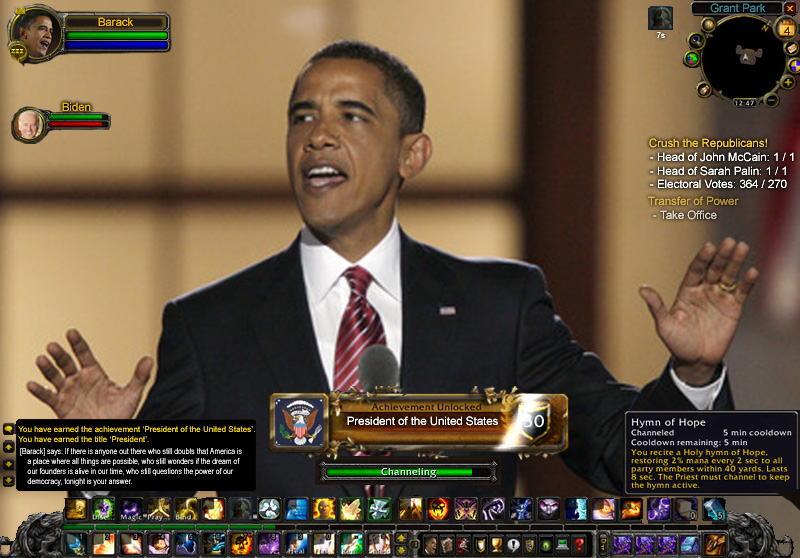
Don't know where it originally came from, but I got it at Balloon Juice. Please do click to enlarge.
-
"Keywords: urban gardening, civic renewal, integrated design, participatory environments, artificial intelligence, virtual ecosystems, design for public spaces"
-
Still more theory:
"Developing a single cross-disciplinary body of theory about designing and designs has been of persistent interest in the field of Design Research over the last 50 or so years. In spite of the obvious benefits and the substantial volume of research undertaken, a coherent body of theory and knowledge has not yet emerged.
It has recently become clear that this failure is closely linked to weaknesses in the philosophical foundations of the field. This paper focuses on identifying and resolving some of these weaknesses. "
Dense, but perhaps useful."This paper focuses on the structure and dynamic of theory in design research. Problems with existing theory are explored, and a new meta-theoretical method is suggested for assisting the critical analysis, comparison and formulation of design theories and concepts. This meta-theoretical method contributes to building a simplifying paradigm of design research by providing a means to clarify the existing state of design theory in the field, to assist with the establishment of coherence and compatibility between concepts in disparate theories, to validate theory and concepts, and to uncover ‘hidden’ aspects of design theories."
"Sensing is going mobile and people-centric. Sensors for activity recognition and GPS for location are now being shipped in millions of top end mobile phones. This complements other sensors already on mobile phones such as high-quality cameras and microphones. At the same time we are seeing sensors installed in urban environments in support of more classic environmental sensing applications, such as, real-time feeds for air-quality, pollutants, weather conditions, and congestion conditions around the city. Collaborative data gathering of sensed data for people by people, facilitated by sensing systems comprised of everyday mobile devices and their interaction with static sensor webs, present a new frontier at the intersection between pervasive computing and sensor networking."
-
Looks fantastic:
"Living with Things provides an account of consumption in terms of its centrality to our dwelling practices. Its focus is on the home, particularly on the movement of people and things within and through it in everyday habitation. Here dwelling is seen as an activity, as doing things with and to the things to hand around us. Being 'at home' is achieved through living amongst things, as well as amongst people and other non-human presences, such as pets and gardens. Being at home is achieved through what we do with objects, the things that are acquired and stored, that linger around in our homes, sometimes for decades, and which we may eventually get rid of. These ordinary things make dwelling structures accommodating accommodations; they make them homes. Based primarily on a former coal-mining village in North-east England, this book explores practices of inhabitation, from moving in or being modernised, to the daily accommodation of sleep and children."

In Perform or Else, Jon McKenzie uncovers an uncanny relationship between cultural, organizational, and technological performance. His conclusion--that performance will be to the twentieth and twenty-first centuries what discipline was to the eighteenth and nineteenth--is an exhilarating realization of how culture, business, and science have become hyperlinked through globalization.
I never seem to get around to doing the review of the history of performance in design and as a design method.
-
"Ubiquitous computing technologies will have a wide impact on our daily lives in the future. Currently, most debates about social implications of these technologies concentrate on different aspects of privacy and data security. However, the authors of this paper argue that there is more to consider from a social perspective: In particular, the question is raised how people can maintain control in environments that are supposed to be totally automated. Hinting at the possibility that people may be subdued to machines’ autonomous actions we introduce the term “Technology Paternalism”. We elaborate a working definition and illustrate the concept by looking at different examples based on current and future technology. We also dwell on the impacts of ubiquity and control of technology and suggest some approaches to assure a reasonable balance of interests such as a general “right for the last word”."
-
Compostmodern is fertile ground for sustainability. Presented by the San Francisco chapter of AIGA and the AIGA Center for Sustainable Design (CFSD), this interdisciplinary conference explores the range of design thinking necessary to create a socially and ecologically responsible society. Designers, manufacturers and business leaders come together to find inspiration, share knowledge and explore real world opportunities for transforming products, industries and lives.
When I was an undergrad, I had a summer job updating the database of large donors to a university art museum. I pretty soon realized there was a problem: the database didn't allow for two people at the same address to have two different last names - ie, it would not allow me to automatically generate printed address labels for Elizabeth Goodman and Mike Kuniavsky. Apparently, the database designers simply had not conceived of a couple in which one partner did not take the last name of an other. As you can imagine, for an art museum with a substantial number of gay and lesbian donors, this was a major donor relations problem. For the first few weeks, I just typed up those "special" envelopes by hand. Painfully. On a twenty-year-old manual typewriter.
Then the stupidity of the situation hit me - it's not like there were going to be fewer couples (whether straight or same-sex) with different last names in the coming years. And typing up those envelopes was just as likely to create typos. Why not just redesign the database and the entry forms so that we could avoid any chance of insulting wealthy donors who should never receive incorrectly addressed letters?
It took a week.
Apparently, that's not how it works in Maryland.
Under the administration of then-Gov. Robert L. Ehrlich Jr. (R), Maryland law enforcement infiltrated law-abiding protest groups and labeled 53 Americans, who had done nothing wrong, as "terrorists" in a state database shared with federal authorities. (It turns out, their law enforcement database didn't have categories for anti-war activists. Police created "terrorism" categories to make filing easier. How reassuring.)
Every now and again, I'm reminded of the continuing importance of studying how classification systems are made - with Bowker and Star's Sorting Things Out the essential guide:
What do a seventeenth-century mortality table (whose causes of death include "fainted in a bath," "frighted," and "itch"); the identification of South Africans during apartheid as European, Asian, colored, or black; and the separation of machine- from hand-washables have in common? All are examples of classification--the scaffolding of information infrastructures.
In the case of my undergrad art museum, the problem easily solved by changing the default settings for address labels. I understand that changing categorization options for a massive government database is harder. I do. But it's the sheer malignant sloppiness that gets me about the Maryland case.
Either the troopers didn't believe that there would be no consequences for labelling members of an anti-war group "terrorists," or - what's worse - they didn't think there was a difference. There was no way the database problems could be corrected, because the information infrastructure of the War on Terror both promoted and was created by those types of classification decisions.